Phase 7 ran from late 2023 until the summer of 2025 and involved ABCD participants in their young adulthood (about 19–20 years). Participants completed online questionnaires, performed two short cognitive tasks, and took part in physical measurements including movement and sleep monitoring.
Phase 7 combined online questionnaires, short cognitive tasks, and physical measurements to investigate health, lifestyle and mobile device use. This research round was part of the international GOLIAT project (ISGlobal). The GOLIAT project investigates possible effects of electromagnetic radiation (RF‑EMF), with special attention to 5G, on young people. In addition, the ABCD study collaborated with the Department of Psychiatry at Amsterdam UMC, which contributed with questions about gambling.
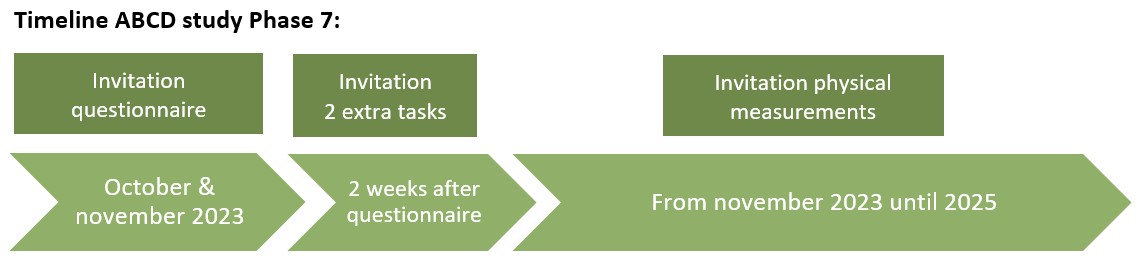
Phase 7 consisted of two parts. The first part consisted of a questionnaire, followed by cognitive tasks. The second part consisted of physical measurements and monitoring of movement and sleep quality.
Part 1: Questionnaire and cognitive tasks
The questionnaire collected detailed information on personal characteristics, lifestyle, substance use, exposure to electromagnetic radiation, menstruation, stress, mental health, gender, cognitive functioning, climate and health, gambling, physical activity, and nutrition.
After completing the questionnaire, participants were invited to complete two additional tasks: a cognitive test (RAVEN and SOPT) and a diet questionnaire.
Part 2: Physical measurements
During the physical measurement sessions several assessments were performed: a finger prick for immediate measurement of blood sugar and fat levels; height, weight, waist and hip circumference; body fat percentage; multiple blood pressure measurements; an ECG (heart tracing) with electrodes; and muscle strength measured with a handgrip dynamometer.
After the measurement visit, participants wore a movement and sleep monitor for 7 days and kept a short diary about their bedtimes.